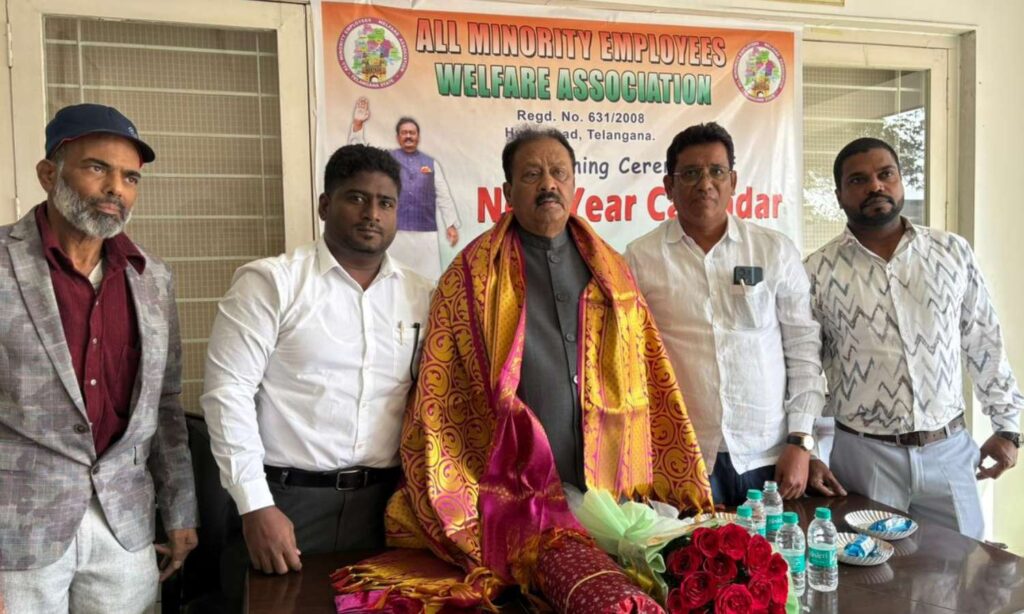
Hyderabad, December 26: Congress leader and Advisor to the Telangana Government Mohammed Ali Shabbir emphasised the need for strong and sustained Muslim political leadership across Telangana, stating that meaningful empowerment was possible only through adequate representation in decision-making bodies.
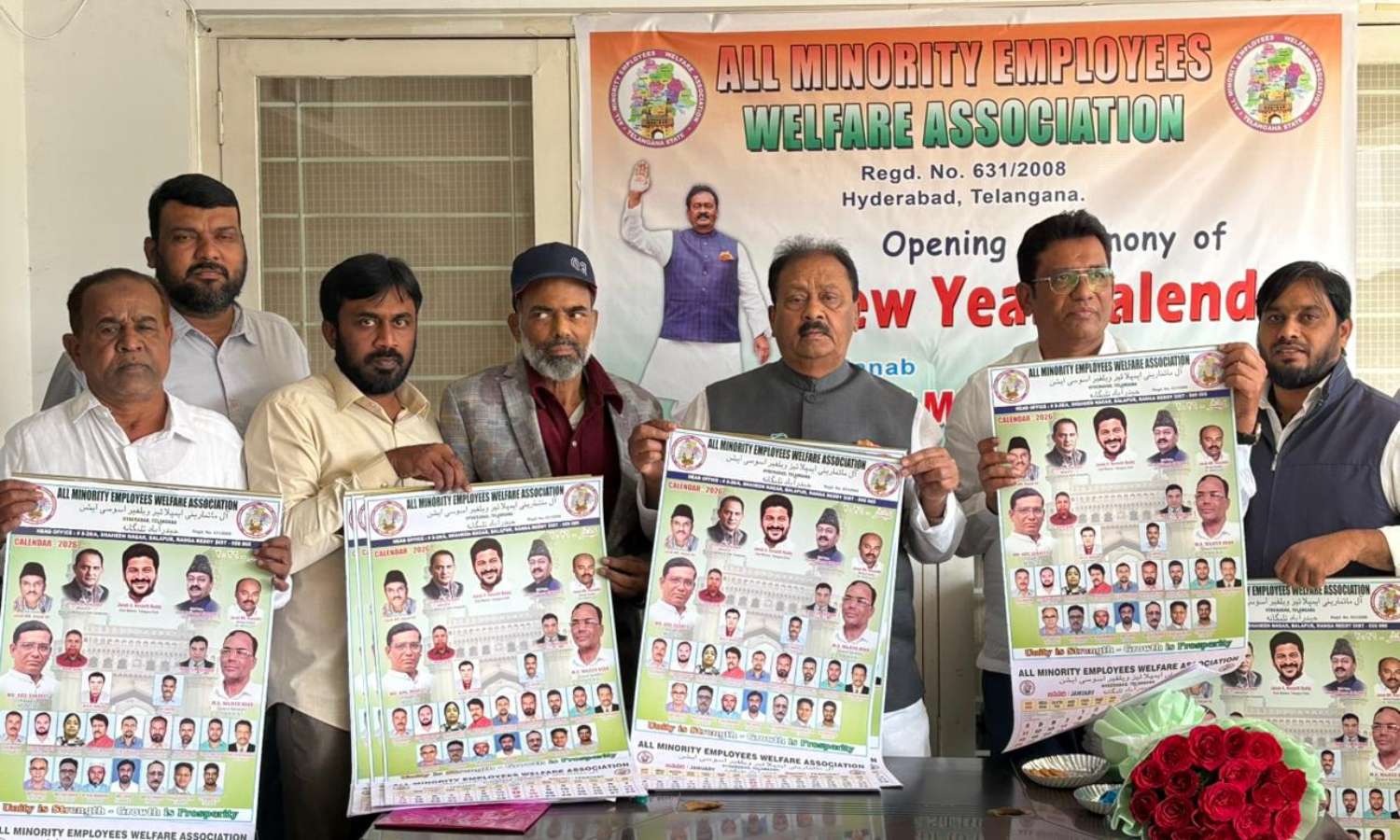
Speaking after releasing the New Year calendar of the All Minority Employees Welfare Association, Shabbir Ali said Muslims constituted nearly 15 per cent of Telangana’s population and required representation in all sectors, particularly in politics. He recalled that the 4 per cent reservation for socially and educationally backward Muslims in jobs and education was introduced in 2004 during the previous Congress government headed by Dr Y.S.Rajashekhara Reddy, when he was part of the Cabinet.
He said the policy had benefited more than 22 lakh poor Muslim families across the erstwhile united Andhra Pradesh, including present-day Telangana. Thousands of Muslim students gained admission into MBBS and other professional courses, while the community also received a 4 per cent share in government recruitments conducted since 2004–05, except during a few years when legal hurdles intervened.
Shabbir Ali said that the Congress government had gone beyond education and employment to ensure the political empowerment of Muslims by including them under the BC-E category. This enabled Muslims to contest elections from seats reserved for Backward Classes, which, he said, led to the election of hundreds of Muslim representatives across rural and urban local bodies. These included Sarpanches, ZPTC and MPTC members, Corporators, Councillors, Ward Members, as well as Mayors, Deputy Mayors and Zilla Parishad Chairpersons.
He added that Muslim representation was also ensured in cooperative societies, agriculture market committees and several other statutory and public institutions. Such measures, he said, ensured that the community had a role not only in availing welfare schemes but also in policy execution and local governance.
Recalling his tenure as a Minister in the Cabinet of former Chief Minister Vijayabhaskar Reddy, Shabbir Ali said the country’s first Minority Welfare Department was created during that period, which later resulted in the introduction of a separate budget for minority welfare. He said decisions impacting lakhs of people could only be taken through political authority and urged the community to stand by its leaders and ensure their electoral success. He cautioned against divisive and communal politics.
Warning Muslims against falling into what he described as political traps laid by the BJP, Shabbir Ali said controversies were often manufactured to divert attention from governance failures. He cited the renewed debate around ‘Vande Mataram’ as an example and urged the community not to react impulsively to such issues.
Explaining the historical context, he said ‘Vande Mataram’ was adopted as India’s National Song by the Constituent Assembly on January 24, 1950, the same day ‘Jana Gana Mana’ was adopted as the National Anthem. He noted that the Assembly, under the declaration of then President Dr Rajendra Prasad, accorded equal respect to both, following earlier recommendations to use only the first two stanzas of the song to ensure wider acceptance.
Referring to the 150th anniversary discussions held in the Lok Sabha in December 2025, Shabbir Ali said the issue was once again politicised, with the BJP accusing the Congress of diluting the song in 1937, while Opposition leaders defended the historical decision as one aimed at preserving national unity.
He said the Congress government in Telangana, led by Chief Minister A Revanth Reddy, was committed to fighting communal forces and was running a genuinely secular administration where all communities and castes had space, voice and freedom. (eom)