- Calls for stronger participation at government events, fearless questioning and community action to protect Urdu
Hyderabad, August 1: Advisor to the Telangana Government Mohammed Ali Shabbir on Saturday urged Urdu journalists to strengthen their professional presence, attend major government and political events and question those in power without fear.
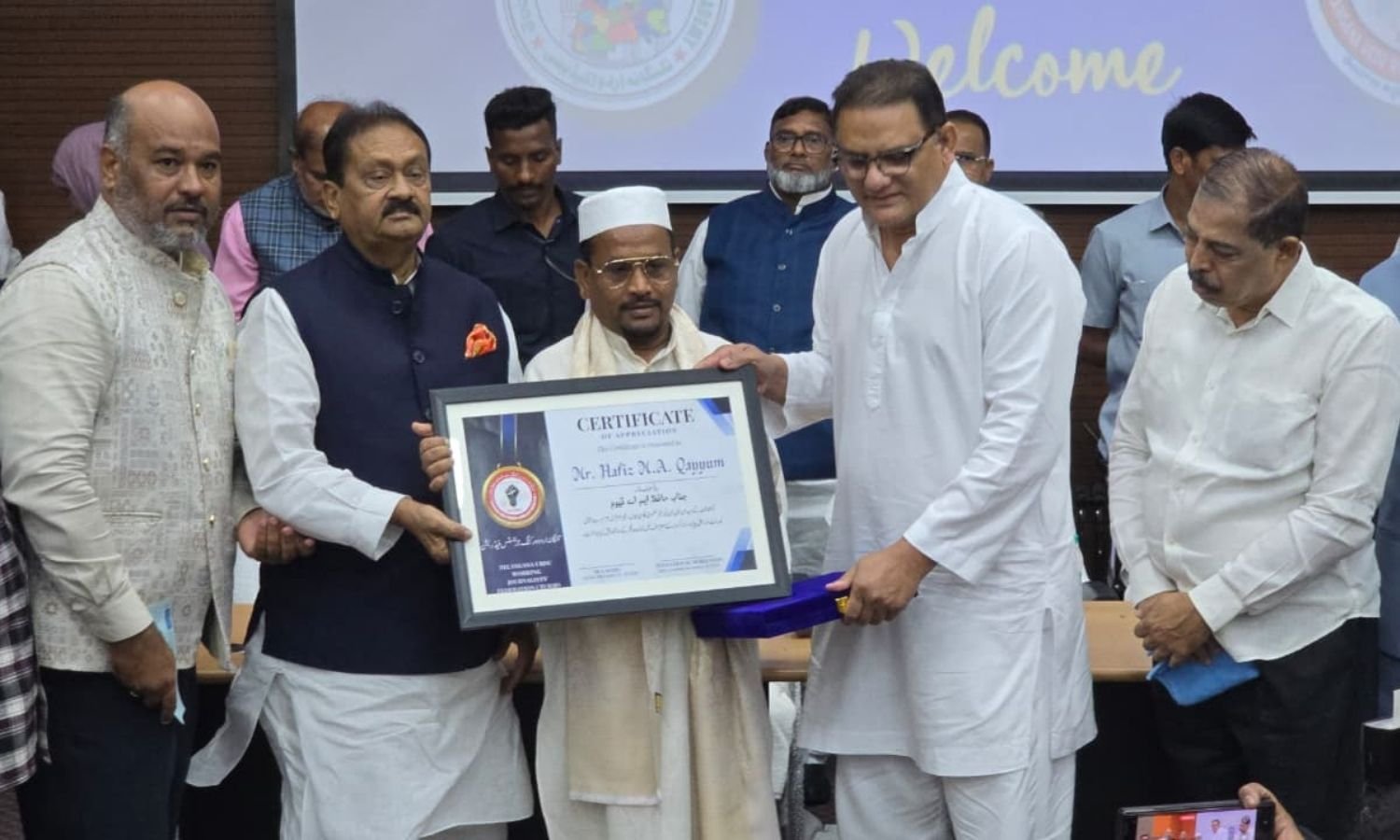
Addressing the 10th anniversary celebrations and Annual Awards 2026 function of the Telangana Urdu Working Journalists Federation at the Telangana Media Academy, Nampally, he said Urdu journalism could grow only when journalists widened their coverage, improved professional standards and asserted their role in public affairs.
Shabbir Ali said Urdu journalists should not confine themselves to Muslim, minority or religious issues. They were journalists first and should report on governance, administration, development, politics and matters affecting all sections of society.
He expressed concern over their limited presence at press conferences addressed by the Chief Minister, ministers, Collectors and senior officials, as well as at District Development Committee meetings and major government programmes.
He assured journalists that they could approach him if they faced difficulty in gaining entry to official events. “If anyone stops you at the gate, call me. I will speak to the officials. But you must come forward, ask questions and display your talent,” he said.
Recalling his association with Urdu, Shabbir Ali referred to his election as an MLA and induction into the Dr M. Channa Reddy Cabinet in 1989-90 at the age of 31. He said he could read and write Urdu, Telugu and English, but had consciously taken up Urdu-related issues because of his deep attachment to the language.
Before Independence, even medical and higher education was available in Urdu in Hyderabad, but the language gradually lost its position after 1947, he said. Urdu later received second-language status and wider recognition during Congress governments. However, official recognition alone would not protect it unless the community pursued its implementation.
“Merely issuing statements will not produce results. Every right has to be pursued,” he said.
Shabbir Ali recalled noticing that Urdu was missing from signage at Kasu Brahmananda Reddy National Park. After he contacted forest officials and senior government representatives, Urdu was added along with Telugu and English.
He said citizens and organisations must remain alert whenever Urdu was excluded from official boards, offices or public institutions. During his tenure as Information and Public Relations Minister, he had also ensured that material explaining the government’s performance was translated and published in Urdu.
He asked journalists to appreciate senior colleagues who had devoted their lives to Urdu journalism and said the profession should revive the confidence and depth once associated with influential Urdu publications.
Referring to the Special Intensive Revision of electoral rolls, Shabbir Ali said coordinated work by community representatives, officials and citizens had produced encouraging results in several districts and urban areas outside Hyderabad, including Nizamabad.
He recalled attending an awareness programme at a mosque in Kamareddy where district and municipal officials interacted with residents. Such engagement showed that community spaces could be used constructively to resolve public issues, he said.
Shabbir Ali also explained the background to the Telangana Government’s Family Register Certificate. He said religious scholars had drawn his attention to Karnataka’s Permanent Resident Certificate system and suggested a similar document for residents facing difficulty due to inadequate records.
He said he discussed the proposal with Chief Minister A. Revanth Reddy, who asked the Chief Secretary and senior officials to examine it and develop an improved system. The government subsequently introduced the Family Register Certificate, which could be obtained online or through MeeSeva centres.
He advised families to maintain consistency in names across school, college, marriage and official records. Changing a woman’s name after marriage or using different versions in documents often created difficulties. The name recorded in educational certificates should continue in all official records, he said.
Shabbir Ali asked Urdu organisations to adopt peaceful democratic methods when the language was ignored in government offices, Collectorates, bus depots or other institutions. They should submit memoranda and give officials a reasonable deadline. If there was no response, they could hold demonstrations or relay hunger strikes.
However, he said the government alone could not be blamed for Urdu’s decline. Many parents were sending their children to English-medium institutions and were unwilling to select Urdu even as a subject. Some students were opting for Arabic in Intermediate because they believed it would help them secure higher marks.
He recalled intervening after a senior official complained that his daughters could not study Urdu at St John’s College. The management said it needed at least 12 to 14 students to offer the subject and meet the cost of a teacher.
“Many people earn their livelihood through Urdu but do not encourage their children to study it. A language cannot survive through government orders alone. Both the government and the community have responsibilities,” he said.
He praised field journalists and photographers who covered events despite storms and heavy rain. Recalling an earlier generation of reporters who regularly questioned senior political leaders at Gandhi Bhavan, he said the same courage must return.
“You must question us. Ask where the government has gone wrong. Criticise the government. It is your freedom and your strength, and it gives you your identity,” he said.
He urged journalists to raise their professional standards and make Urdu journalism visible at every major public forum. (eom)